Should You Repair an Old Book?
Put the tape down. When repair destroys a book's value, when professional conservation is worth paying for, and what you can safely do at home.
Robin Swain
Author
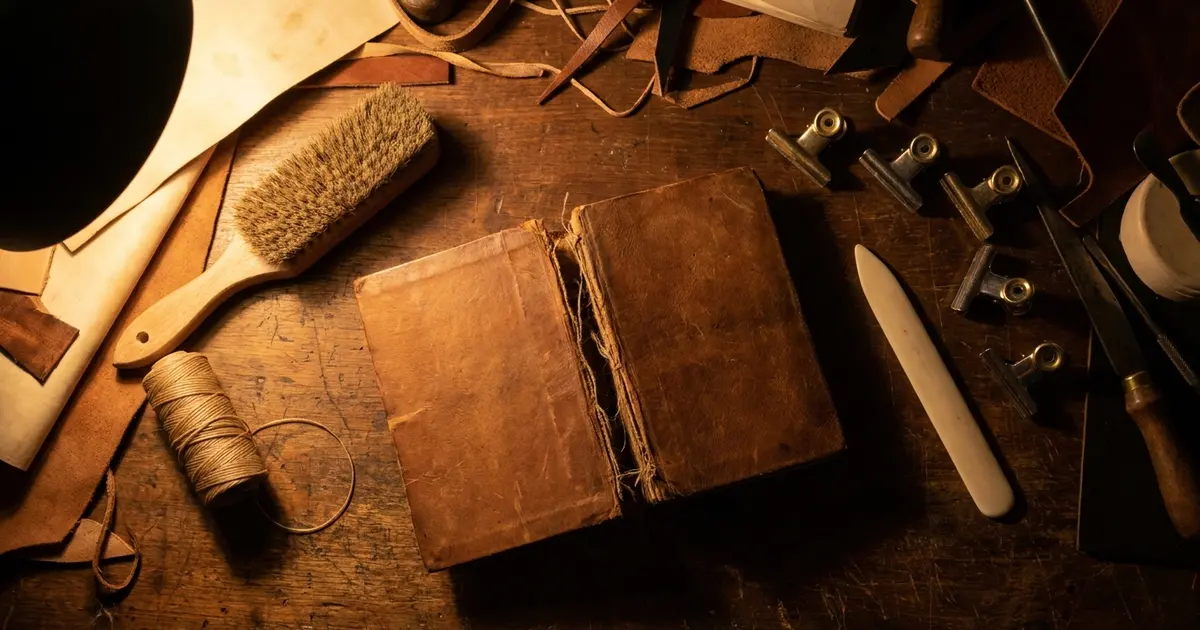
An old book with a loose spine on a bookbinder's workbench, surrounded by thread, a brush, and clamps.
The spine is loose, the jacket has a tear, and there is a roll of tape within reach. This article exists to get between you and that tape.
Whether to repair an old book is really a money question wearing a craft question's clothes. The answer depends almost entirely on what the book is worth, and the most expensive mistakes are made in the first five minutes with household supplies.
The short answer
- Never tape. Tape stains permanently and turns a small honest flaw into a large ugly one. To a collector, tape is worse than the tear it covers.
- For a book with collector value, do nothing yourself. An unrestored copy with honest wear beats an amateur repair every time.
- Professional conservation is worth it when the book's value clearly exceeds the cost of the work, or when the damage threatens the book's survival.
- For a cheap book you love, repair away. A $10 reading copy exists to be read, not preserved.
The tape rule, and why amateur repair backfires
Collectors pay a premium for originality. A first edition with a chipped jacket and a bumped corner is a first edition with honest wear; the same book with cellophane tape yellowing along the jacket folds is a damaged copy. Tape adhesive soaks into paper, browns with age, and cannot be undone cleanly. The same goes for household glue on a loose hinge, and a bad repair is harder to fix than the original problem, because now a conservator has to reverse your work before doing theirs.
The uncomfortable rule: on any book worth real money, doing nothing is almost always the more valuable choice than doing something yourself.
Conservation vs restoration, in plain terms
The trade splits professional work into two ideas:
- Conservation stabilizes: it stops active damage, mends tears with reversible archival materials, secures a failing binding, and otherwise keeps the book from getting worse while changing as little as possible.
- Restoration beautifies: rebacked spines, color touch-ups, replaced endpapers, work aimed at making the book look closer to new.
Collectors broadly accept sensible conservation. Restoration divides them: some pay more for a handsome restored copy, others want untouched originals only, and every restoration must be disclosed when selling. An undisclosed restoration discovered later is treated as deception, not craft.
When professional work is worth paying for
The math is unsentimental: conservation is skilled labor, and it only makes financial sense when the book's value carries it.
- Worth it: a genuinely valuable book with damage that threatens it, a detached board, a failing sewing structure, active mold. Stabilizing protects the asset.
- Sometimes worth it: family heirlooms you intend to keep forever. You are buying the book's survival, not resale value, and that is a legitimate reason.
- Not worth it: common books and rough reading copies, however old. Rebinding or professional cleaning costs several times what most worn old books bring. This is most books, and it is why the first step is always finding out what you have.
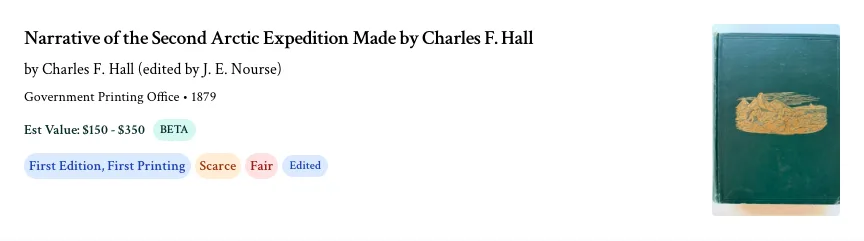
Here is the math on a real book. An 1879 first edition of Hall's Narrative of the Second Arctic Expedition, government-printed, scarce, and in Fair condition, comes back with an estimate of $150 to $350. Dealers ask around $500 for clean, complete copies with the big folding map intact. That gap is exactly the case where professional stabilization can pay for itself, and exactly the book where a strip of tape would burn real money.
If the assessment comes back in the tens of dollars, repair it for love or read it as is. If it comes back in the hundreds or more, hands off, and talk to a professional conservator before anything touches it.
What you can safely do at home
None of this requires touching the book with adhesive:
- Protect the jacket with a removable archival mylar cover. It adds no value by itself, but it stops the most common damage, and it is completely reversible.
- Store it well: upright, supported by neighbors, out of direct sun, away from damp basements and hot attics. Light fades spines; moisture is worse.
- Handle it kindly: clean dry hands, no food, no dog-earing, and never pull a book off the shelf by the top of its spine.
- Box the fragile ones. A simple archival slipcase or clamshell box protects a fragile book better than any repair, and changes nothing about the object.
The theme: everything safe is reversible. Everything risky is permanent.
Decide with the value, not the sentiment
The whole decision hangs on one number you probably do not have yet: what the book is worth. FirstFolio is an AI tool that identifies and values old books from photos. It identifies the edition and printing, grades the condition, and returns an estimated market value range in about 60 seconds, which tells you which side of the repair math your book sits on before you spend anything, or ruin anything.
You can check two books free, no card required. Find out before you repair.
Frequently asked questions
Does repairing a book decrease its value? Amateur repair almost always does, tape and household glue especially. Professional conservation that stabilizes a valuable book is broadly accepted; restoration is a matter of taste and must always be disclosed.
Should I tape a torn dust jacket? No. Tape browns, stains, and permanently damages the jacket. Put the jacket in an archival mylar cover instead; the tear stays honest and the jacket stops getting worse.
What is the difference between book conservation and restoration? Conservation stabilizes a book with minimal, reversible intervention. Restoration alters it cosmetically to look closer to new. Collectors accept conservation more readily than restoration.
Is book restoration worth the cost? Only when the book's value clearly exceeds the price of the work, or when the book is a keeper whose survival matters to you regardless of resale.
How should I store old books to avoid repairs? Upright and supported, out of direct sunlight, in stable indoor humidity, with fragile jackets in mylar covers. Good storage prevents most of the damage people later try to repair.
Related reading: