How to Sell a Rare Book Without Leaving Money on the Table
A step-by-step guide to selling a rare book or a first edition: confirm what you have, find its real value, pick the right buyer, describe it like a dealer, and ship it safely.
Cub McKinnon
Author
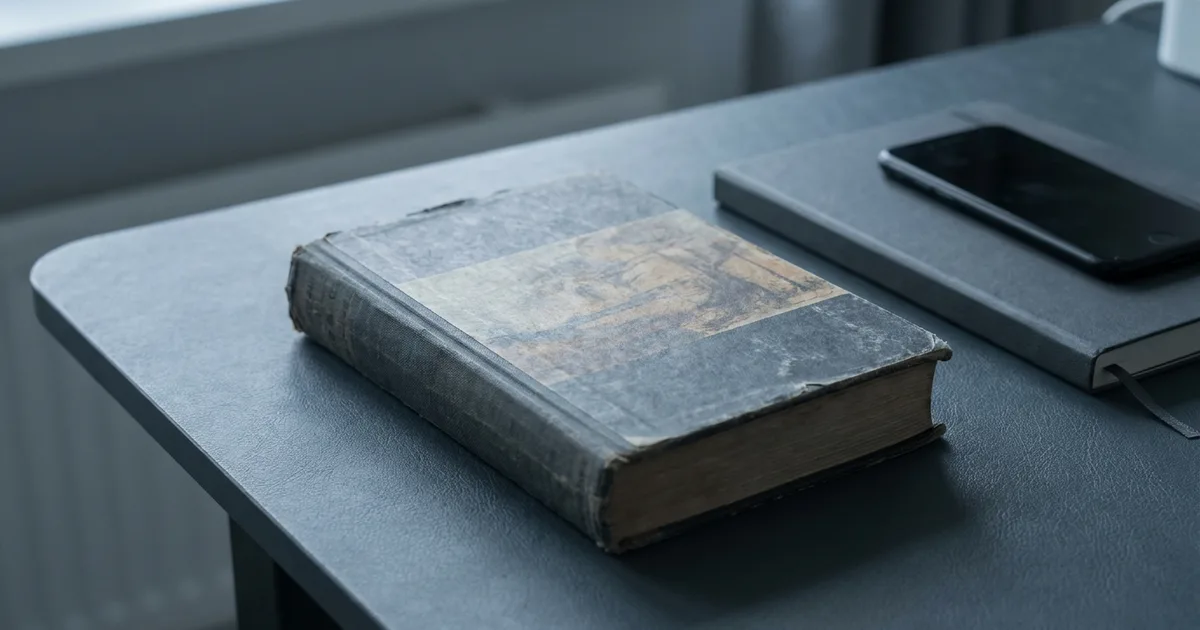
A single worn old hardcover set apart on a slate desk, with a closed notebook and a phone beside it.
You have a book that might be worth real money. Maybe a bookseller told you so, maybe it turned up in a relative's library, maybe you bought it years ago and it has appreciated. Now you want to sell it, and you want to get what it is actually worth.
Selling a rare book well is a process, and most of the money is made or lost before the book is ever listed. Sell a first printing as "an old copy" and you give away the premium. Sell a later printing as a first and the buyer sends it back. Ship a $400 book in a padded mailer and you may not have a book to sell.
Here is how to do it properly, in order.
The short answer
- Confirm what you have. Edition, printing, book club or trade, dust jacket present or not. Get this wrong and every step after it is wrong.
- Find the real value from completed sales for the same edition in the same condition, not from asking prices.
- Match the buyer to the value. A specialist dealer or auction house for a valuable book, a marketplace for a mid-value one, a bulk sale for the rest.
- Do not clean, repair, or improve it. Sell it as it is.
- Describe it the way a dealer would, flaws included, with good photos.
- Price and negotiate knowing the difference between retail and what a dealer will pay.
- Pack it properly and ship it tracked and insured.
Step 1: Confirm what you actually have
Everything depends on this. "Rare book" is a claim, and the buyer will check it. Before you go any further, settle three questions.
Which edition and printing is it? The first printing of the first edition is usually the only one collectors pay a premium for, and the difference between a first printing and a third can be the difference between hundreds of dollars and a few. Read the copyright page for the edition statement, the number line, and the date. How to Tell If a Book Is a First Edition walks through it publisher by publisher, and How to Read a Book Number Line covers the printer's key.
Is it a trade edition or a book club edition? Club editions copy the trade first's look, sometimes down to the words "First Edition" on the copyright page, and are worth a fraction of it. Check the jacket flap for a printed price and the back board for a blind stamp. How to Spot a Book Club Edition has the tells.
Is the dust jacket present, original, and unclipped? On a collectible hardcover from the last century, the jacket can be most of the value. A missing jacket, a price-clipped jacket, or a jacket from a later printing married to a first-printing book each change the number. See Do Dust Jackets Affect a Book's Value?.
One warning about tools. A barcode scanner app cannot do this step. An ISBN identifies an edition, not a printing, and books printed before about 1970 have no ISBN to scan at all. A scan tells you the title, which you already knew. The identification has to come from the pages themselves, either your own reading or a tool that reads them for you. FirstFolio vs book scanner apps explains the difference in detail.
Step 2: Find out what it is really worth
Once you know the edition, look up what that edition has actually sold for in that condition. Two rules keep this honest.
Use sold prices, not asking prices. A marketplace search for your title will turn up copies listed at wildly different numbers. Those are hopes. Completed and sold listings, dealer catalogues that have cleared, and auction results are the evidence. A book listed at $900 that has sat unsold for three years is not a $900 book.
Match the condition. Rare book values are quoted for a specific condition, and the drop from Fine to Very Good to Good is steep. Grade your copy the way a dealer would, and be hard on it: a cracked hinge, foxing, a faded spine, a previous owner's name, a torn jacket. Book Condition Grading Explained lays out the scale. If you inflate the grade, the buyer will not.
Most old books, including many first editions, are not worth much. If the sold comparables come back at $20, that is useful information: it tells you to spend no more time on this book than $20 deserves. Is My Old Book Worth Anything? covers what actually drives value.
When the comparables suggest hundreds or more, or you are settling an estate or insuring the book, it is worth paying for a professional opinion before you sell. How to Get a Book Appraised covers the options and what they cost.
Step 3: Pick the buyer that fits the value
The value decides the venue, which is why steps 1 and 2 come first.
- A genuinely valuable book (high hundreds and up): a specialist rare book dealer who handles that author or period, or an auction house with a books department. Dealers give you a fast, certain sale at a wholesale price. Auctions can reach a higher price but take months, charge a seller's commission, and carry the risk of a low hammer or no sale.
- A mid-value collectible you can identify with confidence: a marketplace like eBay, AbeBooks, or Biblio, where you set the price and reach collectors directly. More work, more of the retail price kept.
- A common old book: a local used bookstore, a bulk lot, or a donation. Listing it alone is not worth your hour.
Where to Sell Old and Rare Books goes through each venue, what it pays, and what it costs you.
Step 4: Do not clean, repair, or improve it
This is the step that separates people who have sold books before from people who have not.
Do not tape a torn jacket. Do not erase a pencilled price. Do not glue a loose hinge, re-back the spine, or wipe the boards with anything wet. Do not remove a bookplate. Collectors and dealers want a book in original, unrestored condition and will pay less for an amateur repair than for the flaw it was hiding. A torn jacket is a torn jacket; a taped jacket is a damaged one.
The exceptions are small. You can dust the top edge with a soft dry brush and slip the jacket into a clear archival protector, which buyers appreciate. Anything beyond that, leave to a conservator, and only for a book valuable enough to justify it. Should You Repair an Old Book? covers where that line sits.
Step 5: Describe it the way a dealer would
A rare book listing is a catalogue entry, not an ad. Buyers of rare books are looking for specifics, and the specifics are what let them trust a stranger. Cover, in this order:
- Author, title, publisher, place, and year, taken from the title page and copyright page, not from memory.
- The edition and printing, with the evidence: "First edition, first printing, number line 1 through 10, 'First Edition' stated on the copyright page." If a point is uncertain, say so.
- The binding: cloth or boards, colour, any decoration, and whether it matches the first-printing description for that title.
- The dust jacket: present or not, original to the printing, the printed price, whether it is clipped, and its condition separately from the book's.
- Condition, with every flaw named. "Very Good in a Very Good jacket. Light shelf wear to the board edges, spine ends gently bumped, previous owner's name in ink on the front free endpaper. Jacket with a short closed tear at the head of the spine and light toning to the spine panel. Unclipped." Flaws named up front do not lower the price much. Flaws discovered on arrival end the sale.
- Anything special: a signature or inscription (say whether you can vouch for it), a bookplate, a laid-in letter, provenance.
Then photograph it. Front board, spine, back board, the jacket flaps, the title page, the copyright page, and a clear shot of every flaw you named. Natural light, no flash, a plain background. A signature gets its own photo.
If you would rather not write this from scratch, a FirstFolio assessment produces a catalogue-style description with the edition, condition, and flaws, which you can copy into a listing and correct against the book in your hand.
Step 6: Price it and negotiate
Know which number you are talking about. Retail is what a collector pays a dealer. Wholesale is what a dealer pays you. As a rough rule, a dealer buying for stock will offer somewhere between a third and half of what they expect to sell the book for, because they carry the risk, the time, and the customer. That is not a lowball; it is the trade. If you want the retail price, you have to do the dealer's job yourself on a marketplace and wait for the buyer.
On a marketplace, price against the sold comparables for your condition, slightly under the cleanest recent sale if you want it gone, at it if you are patient. Leave a little room for offers. Do not price against the highest asking price you can find; that copy is still for sale for a reason.
At auction, ask for the estimate, the seller's commission, and any photography or insurance fees in writing before you consign. Ask whether you can set a reserve. Understand that the buyer pays a premium on top of the hammer price, and the hammer price minus your commission is what you receive.
For consignment with a dealer, ask for the split, the term, and what happens if the book does not sell, and get it in writing.
Step 7: Pack it and ship it safely
More rare books are damaged in the mail than on the shelf. Once it is sold:
- Wrap the jacket in an archival protector or a sheet of clean paper so it cannot rub.
- Wrap the whole book in paper or bubble wrap, corners padded.
- Put it in a box with at least an inch of cushioning on every side, and put that box inside a second box for anything valuable. A padded mailer is not packaging for a rare book.
- Ship tracked, insured for the sale price, with a signature required. Slow, cheap services offer little protection if a claim is needed.
- Photograph the packed book before sealing it, for your own records.
Selling first edition books specifically
Most of the questions people have about selling first editions come down to the same few points.
A first edition is not automatically valuable. Every book has a first edition. The ones that command a premium are first printings of books people collect, in good condition, with the jacket. A first edition of a forgotten novel is a used book.
Modern firsts live or die by the jacket. For collectible hardcovers from roughly the 1920s onward, a copy without its original jacket can be worth a small fraction of a jacketed one. Say clearly what you have.
Later printings are honest to sell, just not as firsts. A second or fifth printing of a collected title has a market, at a lower price. Describe it accurately and it will sell to someone who wants a reading copy.
Signed copies need care. A real signature adds value, sometimes a lot, sometimes a little, depending on how freely the author signed. State whether the signature came with provenance, and never describe it as authenticated unless someone qualified has done so. Are Signed Books Worth More? covers when a signature matters.
Sets and runs can be worth more together. If you have a complete run of an author's firsts or a numbered series, get a price for the set before you break it up.
When a rare book is not worth selling one by one
Be honest with yourself about the number from step 2. If the book is worth $15, the listing, the questions, the packing, and the trip to the post office cost you more than the sale returns. Put it in the bulk pile and spend the effort on the one that is worth it.
The same logic scales up. If you are working through a whole library, most of it will be common and a few books will carry most of the value. The job is finding those few quickly, then selling them properly using the steps above. What to Do With a Box of Inherited Books covers that triage.
The faster way through steps 1 and 2
Reading copyright pages, checking for book club tells, grading condition, and hunting for sold comparables is the right work, and it is slow when you have more than one book or an author you do not know.
FirstFolio is an AI tool that identifies and values old books from photos. Photograph the cover, the title page, the copyright page, and the jacket, and in about 60 seconds it identifies the edition and printing, grades the condition, and returns an estimated value range, along with a catalogue-style description you can use in a listing. It shows the evidence for each call so you can check it against the book, and it says plainly when a book is common.
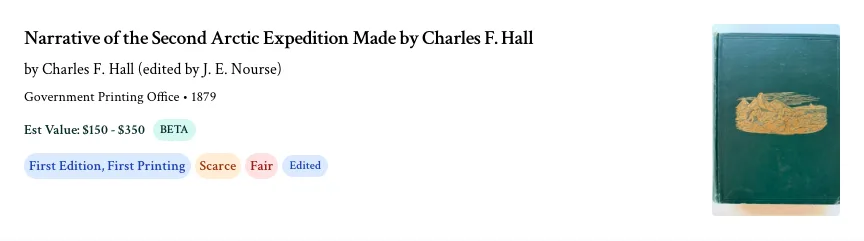
It is a first pass, not an appraisal. Use it to sort the pile and to walk into a dealer or an auction house knowing what you have. Two books a month are free, no card. Identify a book.
Frequently asked questions
How do I sell a rare book? Confirm the exact edition and printing, check what that edition has sold for in your book's condition, then choose the buyer that fits the value: a specialist dealer or auction house for a valuable book, a marketplace for a mid-value one. Describe it accurately with every flaw named, and ship it packed in two boxes, tracked and insured.
How much will a dealer pay for a rare book? As a rough rule, a dealer buying outright offers somewhere between a third and half of the price they expect to sell it for. You trade part of the value for a fast, certain sale. Consignment or selling it yourself keeps more of the retail price but takes longer.
Is it better to sell a rare book at auction or to a dealer? A dealer is faster and certain. An auction can reach a higher price for a book with real demand, but it takes months, charges a seller's commission, and the book may sell low or not at all. For a single book below the high hundreds, an auction house may not take it.
How do I sell a first edition book? Prove it is a first printing, not just a first edition, using the copyright page and number line. Confirm it is a trade edition rather than a book club copy. State whether the original dust jacket is present and unclipped. Then price it against sold copies of the same printing in the same condition.
Should I get a rare book appraised before selling it? For a book that comparables suggest is worth hundreds or more, or one involved in an estate, insurance, or a donation, yes. For most books, sold comparables or a photo-based estimate are enough to choose a venue and a price.
Related reading: